
Thin and Holy Places
Where heaven is near...

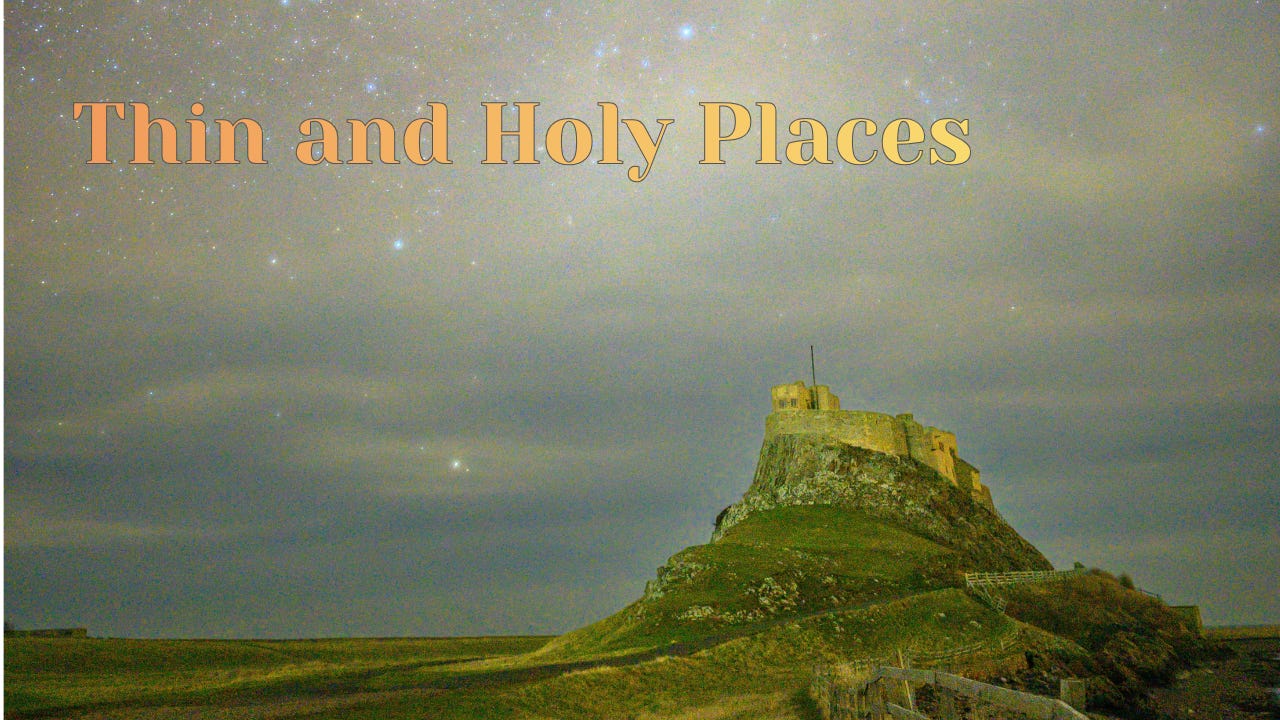
Have you ever noticed that there are places where it seems that heaven is closer? Places where the supernatural is expected, where the voice of God seems louder and clearer, places where you wouldn’t bat an eye if miracles happen, and places where the scriptures open easily, freely sharing their treasures of revelation. In my experience, these are most commonly, either places of awe-inspiring natural beauty or places where there has been a long-term investment, a history of God’s people giving themselves to seeking Him.
BEAUTY POINTS US TO THE BEAUTIFUL ONE
Over the last few years, I’ve become increasingly convinced of the spiritual nature of beauty. Especially the beauty of nature— the creation God spoke into being. Perhaps it’s because I live on the Westcoast of Canada, in a place of stunning beauty, with forests, beaches, mountains, and gardens that are always accessible. I can even watch the sun set at the riverbank down the street, with the pinks, oranges, and purples shifting and changing, illumining the clouds, as the sky darkens into night. I am continually thankful that God has called me to live in such a beautiful place; it’s balm to my soul. Perhaps that’s what makes me see creation’s beauty through a spiritual lens.
But I think we all acknowledge that God Himself is beautiful, and so it should be expected that creation’s beauty points us toward Him. When we are surrounded by it, worship is effortless, it’s like breathing. If I’m reading Revelation right, or Ezekiel, or Daniel, heaven is also stunningly beautiful; primarily because He’s at the centre— for He is the source and wellspring of all beauty. But it is also because heaven is sinless. Nothing evil, distorted, or defiling dilutes the pure glory of this holy place.
Beauty moves us, be it mysterious, majestic, or simple. It’s arresting when it’s spectacular, but it can also be found in simple things we often walk past, like the sun streaming through the lacey cedar boughs or a random field of buttercups growing in an empty lot. Perhaps the greatest draw mankind has ever known is to see the face of God, and beauty points us in that direction.
SACRED HISTORY
However, we also find that thin places can be humble, unimpressive places where there has been a deep history of encounter with God. Places where, like in Smith Wigglesworth’s room, the wooden floor was worn and indented from his frequent kneeling in intercession. Or the historic Welsh chapel, Pisgah, that Evan Roberts built to accommodate the region’s Sunday school, which then became his place of prayer and eventually hosted nightly meetings during the Welsh revival.
Thousands of people deeply encountered Jesus in that simple, little building, confessing their sins with weeping and deep contrition while they turned wholeheartedly in surrender to Christ. It’s as if there is a sense of the “great cloud of witnesses” along with the residual presence of God. Its sacred history of hosting the fire of revival makes this a thin place.
Historical thin places are easy places to pray or to worship; in fact, that’s all that really seems appropriate with their sense of sacredness and God’s presence. Loud, joking conversations are wonderful and fun, but we find they happen outside, and reverence overtakes us as we walk through the doors, so that our conversations shift to whispers. It’s not instructed; it’s our natural response to our awareness that the spiritual atmosphere is different.
HOLY PLACES AND THIN PLACES
Holy places are similar to thin places, the difference being that holy places are formally dedicated to God and are exclusively used for worship. They are primarily church sanctuaries, which is why we experience such a visceral sense of grief when we see churches vandalised, razed by arson, fall into disrepair, or sold to be converted into mosques. Especially historic ones where worship, prayer, the preaching of the scriptures, repentance, and the celebrating of sacraments have been the exclusive activities for generations, or even centuries. Historical layers upon layers of meetings where God comes near, creates an atmosphere that is holy and thin. When it is lost or neglected, something in us cries out, “No!!” We don’t have to be taught to value what we intrinsically know is holy; it’s hard wired into us, perhaps even despite our theology!
It’s that same hard wiring which causes us to object to a sanctuary being used for a political rally or a yoga class. Even if we can’t put words to it, something just feels wrong. Holy means being set apart. It’s no longer “common” space and available as a generic gathering place; it has one dedicated purpose- worship.
“They shall teach my people the difference between the holy and the common, and show them how to distinguish between the unclean and the clean.” Eze 44:23
Not everyone agrees that sacred spaces are still a part of our new covenant life in God. After all, didn’t Jesus say that where two or three gathered, there He is in the midst? Didn’t He say that His people are his temple, not a building? So, the place shouldn’t matter, right? This perspective, I feel, is half right. Yes, Jesus can and does meet us anywhere, and yes, He is in the midst as two or three gather in His name, but in addition to this, don’t underestimate the power of a place actually being wholly and purposefully set aside for the exclusive purpose of worshiping God. He hears those prayers that consecrate the space. He takes them seriously.
I remember when I was on the leadership team of a newer church plant that met in a Hindu banqueting hall. The rent was great, the space was huge, the landlord was kind and accommodating— but it had been dedicated to the Hindu god Kali, you know, the demon god of destruction.
Before it was built, the owners flew in their guru from India to dedicate the land with days of prayers and offerings. Then the building was completed, and they brought him back to further dedicate the building in an elaborate ceremony. For them, it wasn’t just a meaningless ritual, they fully believed that Kali took possession of the land and building.
It was a rather hard place to build a church, to say the least.
I wonder then, (rhetorically) if our God, who is not a deaf and mute idol, nor a demon headed for destruction in the lake of fire, but the One who made and inhabits heaven and earth—is He less able or less interested in responding to our prayers as we dedicate our worship spaces? Are those prayers just sentimental rituals, or do they have power?
There is a local church, doing really good work, which built their facilities to be a multi-purpose space, doubling as a gym. Worship on Sundays, but drop-in basketball on Thursdays.
Is that wrong? Of course not. Is it best? Well, that’s another question, I’d argue no, it’s not. Drop-in basketball might serve the community, and it might be wonderfully missional, but when we place mission and community as having an equal value to worship, and we are ok with our worship space multi-tasking rather than being exclusively dedicated, we communicate that, to us, the community is equally important as worshiping God. We unintentionally diminish His worth and abandon the possibility that we could be cultivating a thin, holy place through a costly history of stewarding a place set aside for Him alone.
PILGRIMAGE
Pilgrimage used to be quite the thing for serious Christians. Especially in the High Middle Ages (1000-1300 AD), Christians would travel to Jerusalem, Rome, or one of the great cathedrals of Europe. Why? I imagine for some it was motivated by works, scoring points to shorten anticipated time in purgatory1, but also, there were some whose hearts simply longed to encounter Him. They believed that places where Christ walked, or where Paul died, had a spiritual history that lingered, marking them, transforming them into thin and holy places.
Interestingly, while we have by-in-large abandoned doing pilgrimage because it became considered a religious act, we still travel to places where God has moved in historic ways. Christians still travel to the Holy Land, to Rome, to the cathedrals, and to places where revival has been poured out, be that Wales or Azusa St. We might frame our trip as touristy or educational, but there is something more. We actually are on pilgrimage; we are still drawn to thin places. We long to be in places where heaven seems near.
If then, we realise that all generations have treasured sacred spaces, what if our generation added more to the map?
Have you ever considered that your church’s sanctuary, or prayer room, or your personal place of prayer, be that in the corner of your bedroom, or the bench in your garden, could be so marked by God’s presence and hold such a rich history of encounter, that future generations would notice and benefit?
I think our generation, as much as any previous generation has had— possesses the same capacity to change the spiritual atmosphere in a place, to the point that it becomes sacred. How? While it’s mostly a mystery, what we can notice is it seems to happen by protecting the space exclusively for God so there is no dilution, by incorporating beauty if possible, but most of all-- by faithfully pursuing intimate, raw, surrendered, encounter with Him.
These could be key factors in creating new thin places, but even if that doesn’t seem to materialize, most certainly the pursuit will serve to shape our hearts as thin places with a deep history of encounter.
And I will be to her a wall of fire all around, declares the LORD, and I will be the glory in her midst. Zec 2:5
Blessed are those whose strength is in you, whose hearts are set on pilgrimage. Ps 84:5
Just to be clear- I don’t believe in purgatory!
I think we are creating a thin place at ERA